
The Human Positioning Manifesto
You Spent Years Building Value.
How Much of It Actually Belongs to You?
Why professionals must turn the expertise they build inside organizations into intellectual assets, reputations, and bodies of work that remain their own.

Within their organization, this professional is highly trusted. They are the first call when a critical project derails.
But step outside their office, and they are completely invisible.


They spend years developing custom workflows, strong instincts, and deep client relationships, only to have their best work locked permanently behind non-disclosure agreements and corporate firewalls.
The result is rented value. That hard-earned expertise sits squarely on the employer's balance sheet.
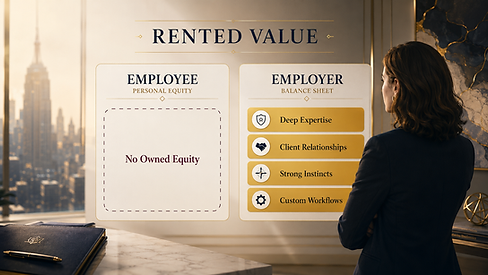

If that employment relationship ends, the professional often walks away with very little tangible evidence of the value they spent years creating.
For decades, it was possible to build a secure career almost entirely inside one or two organizations. That is becoming far less reliable. Companies restructure with little warning, and longstanding clients move on.


At the same time, AI is changing how people and expertise are discovered, evaluated, and recommended, often before a human is involved.
This creates a serious risk. If your company disappears tomorrow, or your division is abruptly cut, the hard-earned reputation you spent years building vanishes with it.


That forces a very uncomfortable question: You spent years creating massive value. How much of it actually belongs to you?
Converting rented career value into owned career equity requires changing where that value lives.


This is the precise function of the Human Positioning System. The system relies on extracting a single core asset, your Human Advantage.

Most people try to explain their worth through easily commoditized job titles or standard qualifications that thousands of others share.


True advantage is built on specific variables. The first two are your innate natural strengths combined with the skills you have deliberately developed over time. The third variable is the distinct lived experience you have endured, encompassing everything you have weathered inside your work and far beyond it.
No algorithm possesses this exact combination.
A machine can analyze and synthesize vast amounts of data, but it cannot bring the unique context, historical instincts, and lived history you bring to a problem. While artificial intelligence will gladly take over rote mechanical tasks, it cannot replicate the human judgment forged through real decisions, real consequences, and actual responsibility.